
CHATBOT.VNMAP.AI
chatbot.vnmap.ai is an AI assistant platform designed for public administration and specialized domains, transforming procedure databases, legal documents, operational guidelines, and specialized knowledge into an accessible natural-language Q&A interface for citizens, businesses, and civil servants. The system is configurable across provincial, ministerial, or domain-specific scopes on a selected, standardized, updated, and governed knowledge base.
Citizens
Ask in natural language or voice; guided step-by-step.
Civil Servants
Quickly look up workflows, legal grounds, and information structured in the knowledge base.
Agencies
Standardize guidance channels, measure citizen demand, and expand 24/7 service.
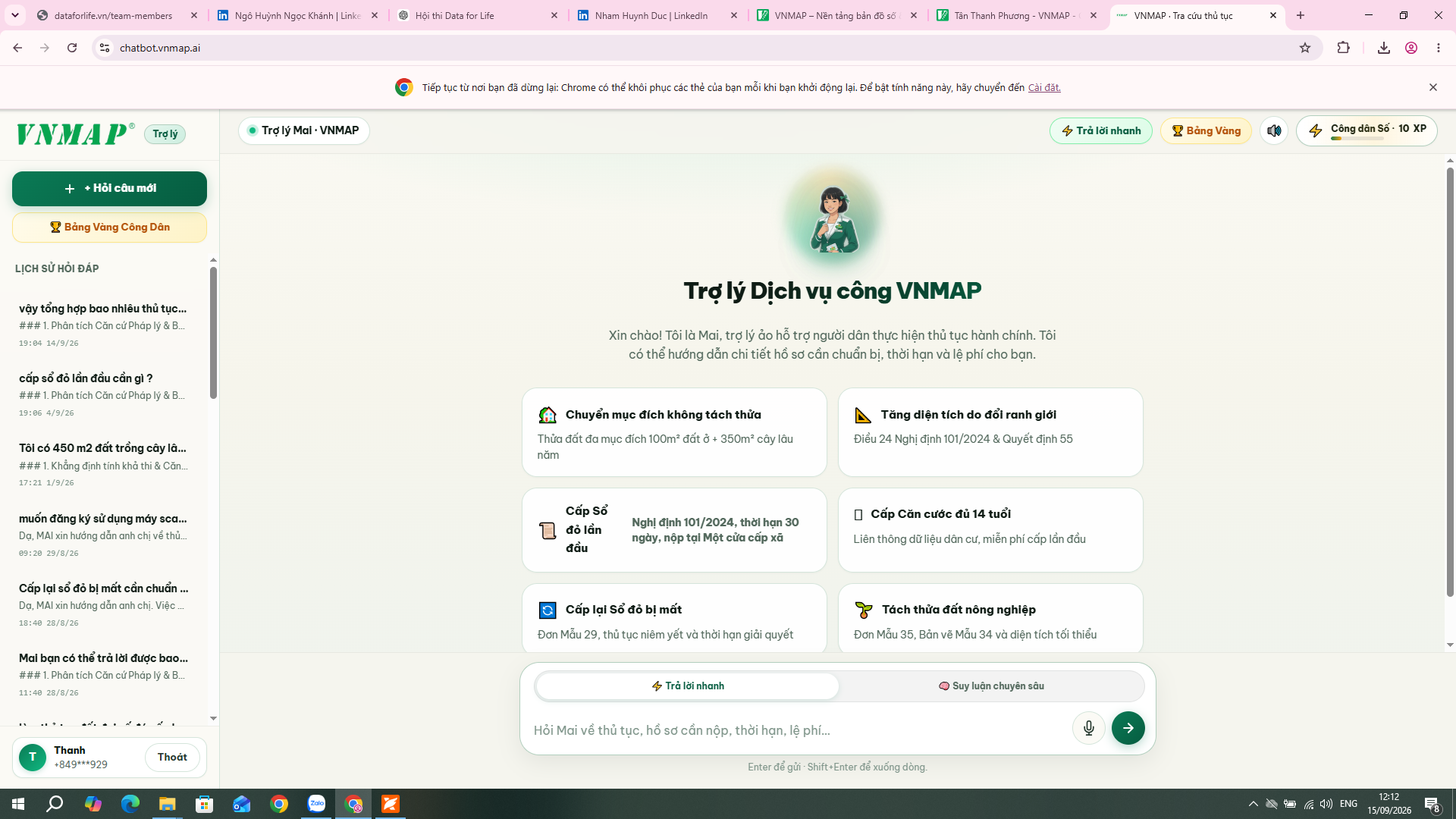
An intelligent interface layer between users and public administration data.
From “having public services online” to “citizens truly understanding and completing them”
The bottleneck lies not only in digitizing procedures, but also in access, correct comprehension, and accurate initial preparation.
Five Practical Bottlenecks
Citizens describe needs in everyday language, whereas administrative systems organize by procedure name, procedure code, agency, and domain.
A single procedure may involve dossier components, forms, conditions, order of steps, processing time, fees, implementing agencies, and multiple legal documents.
Legal documents, public announcements, and professional guidance change over time; without standardized, updated data, AI answers risk lacking basis or being outdated.
Elderly citizens, people with limited digital skills, or remote residents struggle with searching, reading lengthy regulations, identifying forms, and navigating multiple portals.
Front-desk officers repeatedly handle basic inquiries, whereas specialized resources should be focused on complex cases and official decisions.
Not creating another static data repository, but building an AI layer that guides users from EVERYDAY QUESTIONS to STRUCTURED ADMINISTRATIVE GUIDANCE.
Three Gaps chatbot.vnmap.ai Bridges
Language Gap
Citizens express everyday needs; the system must understand intent to locate the right procedures.
Data Gap
Scattered information is organized into a structured knowledge base with explicit sources and scopes.
Service Gap
24/7 multi-device guidance; requests beyond AI scope are handed off to authorized civil servants or agencies.
CHATBOT.VNMAP.AI: Beyond a Conventional Q&A Chatbot
An AI assistant platform configurable for provinces/cities, ministries/sectors, or specialized domains.
| Capability Layer | Conventional Chatbot | CHATBOT.VNMAP.AI |
|---|---|---|
| Understanding Needs | Keyword and exact prompt matching | AI detects user intent and context to route queries to the relevant knowledge base |
| Knowledge Source | Generic LLM training data | Governed administrative procedures, legal documents, guidelines, and standardized domain data |
| Response Generation | Generates ungrounded answers | Retrieves → synthesizes → explains → guides; prioritizes official sources and legal references |
| Interaction Modalities | Text-only | Text and Voice; supports document/image reading and configurable Document AI/OCR |
Core Platform Capabilities
Natural Language Administrative Q&A
Query and locate procedures using natural everyday language; step-by-step guidance tailored to user context.
Voice AI Interaction
Voice interactions reduce keyboard reliance and simplify access for diverse citizen groups.
Configurable Document AI & OCR
Reads document files and images, recognizes and extracts data via Document AI/OCR, and validates completeness within scope.
Data Mapping, Validation & AI Autofill
Integrates with VNMAP Data Mapping, Validation, and AI Autofill components to advance from Q&A to dossier preparation when integration permits.
One Platform – Multiple Knowledge Bases – Multiple Domains – One Unified Q&A Experience
Data-Centric Foundation – Grounded & Responsible AI
Configurable Data & Knowledge Sources
Built upon governed public administration and specialized knowledge bases rather than unverified generic model training data.
National
National Public Service Portal; official public guidelines and authorized data.
Ministries & Sectors
Procedures, publication decisions, workflows, documents, and sector data.
Localities
Local administrative procedures, internal/public workflows, and authorized data.
Legal Framework
Laws, decrees, circulars, decisions, and related regulatory guidelines.
Specialized Domains
Land, construction, and other domains configured per deployment scope.
Q&A / Quality Control
Scenario query sets, test cases, feedback, and quality control baselines.
Proposed Data Pipeline
AI Architecture: From Natural Query to Grounded Answer
Architecture prioritizes governed retrieval, strict scope boundaries, and human handoff when evidence is insufficient.
Luồng xử lý truy xuất có kiểm soát (AI Retrieval Rail)
Three Responsible AI Principles
No Presumed Authority
AI never establishes rights, obligations, or administrative conclusions.
Traceable & Grounded
Important answers must cite valid sources and references from the knowledge base.
Explicit Stopping Points
When evidence is insufficient, AI asks clarifying questions, declines conclusions, or hands off to officers.
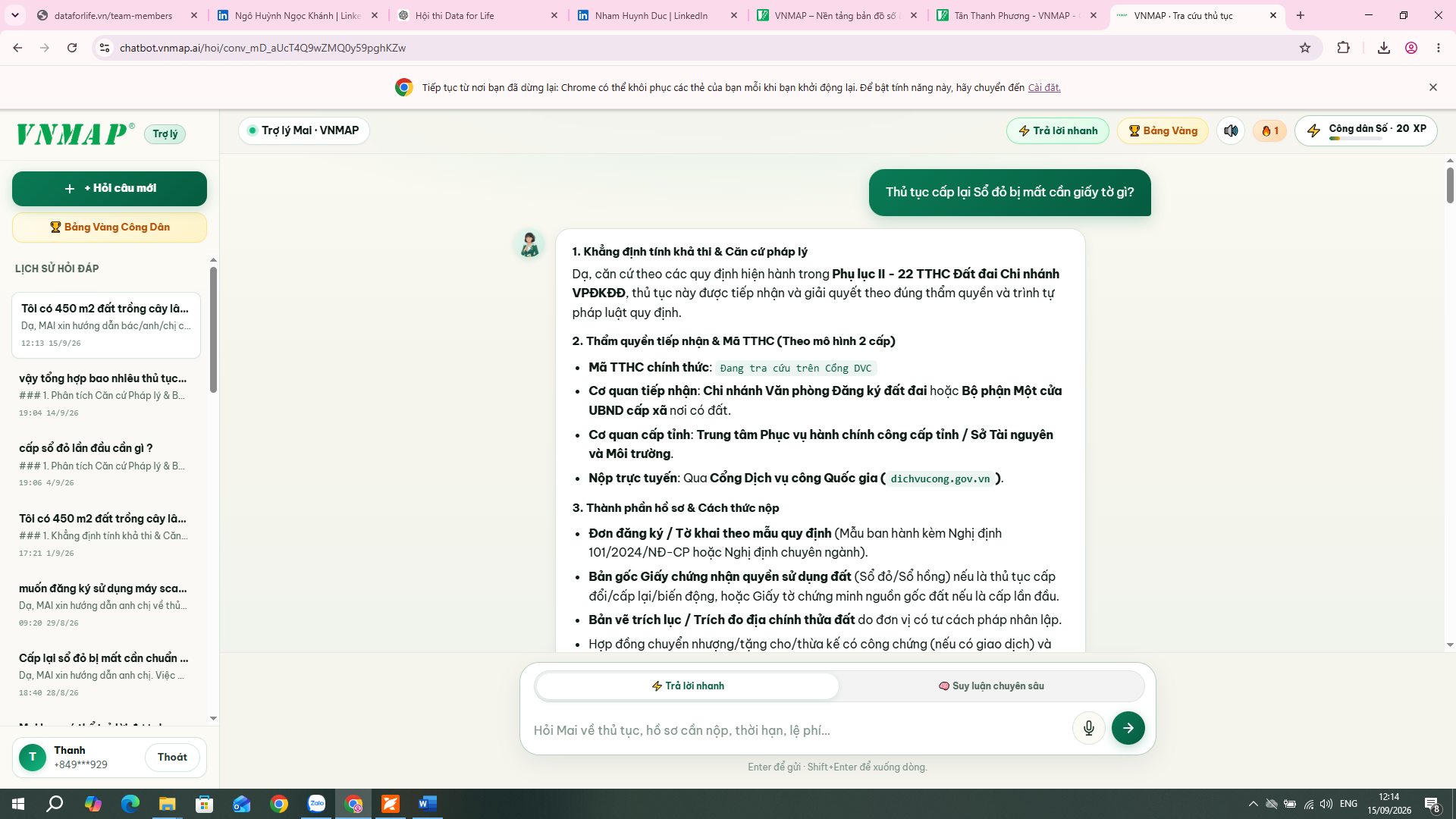
Sample answer demonstrating structured sequence, required documents, and official legal references.
From “I want to do this” to “I know what I need to do”
Designed so citizens do not need prior knowledge of exact administrative procedure names.
Speak / Type Intent
User describes what they need in everyday natural language.
AI Detects Intent
Identifies domain, applicant category, and matching administrative procedures.
Knowledge Retrieval
Retrieves information strictly within configured and governed data boundaries.
Step-by-Step Guidance
Explains required documents, workflow sequence, competent authority, deadlines, and notes.
Voice / Document AI
Engages via voice or reads document images/files when feature is configured.
Validation & Form Assistance
Cross-checks fields, warns of missing items, and connects to Autofill where integrated.
User Confirmation
Citizen reviews and confirms all information before proceeding.
Handoff to Civil Servant
Inquiries exceeding AI scope escalate to support staff or authorized agencies.
Mục tiêu trải nghiệm / UX Goal
User experience goal: Never force citizens to learn system operations; the system adapts to help citizens understand what to do.
Đa kênh tiếp cận / Omnichannel
Access channels: responsive browser on phones and laptops, no app install required; configurable for Kiosks, service desks, and other digital touchpoints.
Specialized Land Administration Assistant: Proving Capability on Complex Realities
Land administration involves voluminous regulations, intricate scenarios, and strict jurisdiction boundaries—a benchmark proving ground for governed AI.
What the Assistant Can Support
- Lookup and plain-language explanation of land administrative procedures within configured data scope.
- Guide citizens on identifying required dossier components, forms, workflow steps, agencies, deadlines, and notes.
- Demystify technical terminology, processes, and legal grounds with direct links to official reference sources.
- Receive situational inquiries and classify needs prior to citizen visits to specialized authorities.
- When configured, read files/images to verify informational completeness without replacing official state legal appraisal.
Mandatory Boundaries Kept
AI Assists
Lookup – explanation – guidance – source linking – information preparation.
AI Never Assesses Rights
Does not determine land use rights, disputes, distraints, or legal status of land parcels.
AI Never Establishes Obligations
Does not establish citizen obligations, financial liabilities, or final settlement outcomes.
AI Never Decides
Does not approve dossiers, issue administrative decisions, or substitute for authorized civil servants.
“AI stands before the threshold of official authority: empowering citizens to understand and prepare; administrative decisions remain with authorized agencies.”
Data Security, Output Governance, and Scope Boundaries
A public administration chatbot is valuable only when users know its evidentiary sources, the system knows when to stop, and governing agencies retain oversight.
Three Pillars of Governance
Data Governance
Rigorous control over provenance, versioning, jurisdiction scope, update schedules, and QA processes.
AI Governance
Quality/confidence gates, session logs, feedback loops, regression testing, and escalation mechanics.
Access Control
Role-based administrative privileges, strong authentication, and audit logs according to deployment architecture.
Data Minimization & Privacy Principles
Collect only the minimum data required for guidance; isolate conversational data from authoritative transactional systems.
Within the knowledge assistant scope, citizens are never prompted by default to provide citizen IDs, photo IDs, financial data, land certificates, or private records for AI evaluation.
When users proactively choose to submit files or images, data processing, retention, and deletion policies must be explicitly disclosed per deployment configuration.
Enforce industry-standard security protocols including HTTPS/TLS, encryption, role-based access, audit logging, backups, and anomaly monitoring.
Never connect to or extract from restricted specialized databases without formal authority, verified integration mechanisms, and approvals.
Legal Scope of the Chatbot
The assistant functions strictly as an informational and procedural guidance tool; it is not an administrative docketing, appraisal, or adjudication system unless integrated under explicit approval and legal authority.
“The closer AI gets to citizens, the stricter data governance and public accountability must be.”
Measuring Real-World Efficacy and Structured Scaling
Pilots measure not merely model speed, but comprehensively assess data quality, answer validity, user satisfaction, and operational efficiency.
9-Dimension Quality Framework (KPI Framework)
Procedure Accuracy
Percentage of user queries routed to the correct procedure/domain against ground-truth benchmarks.
Source Grounding
Percentage of answers grounded in valid, currently effective legal sources in the test suite.
First Response Quality
Proportion of answers satisfying procedural accuracy criteria on the first exchange.
Task Completion
Rate of citizens successfully obtaining actionable procedural guidance without external intervention.
Time-to-Guidance
Elapsed time from initial question to receiving sufficient instruction to commence preparation.
Escalation Quality
Accuracy in recognizing ambiguity or boundary limits and escalating to human officers instead of hallucinating.
User Satisfaction
Satisfaction metrics covering clarity and ease of use, with sub-segment tracking for elderly users when feasible.
Data Freshness
Adherence to SLA updates following promulgation of new legal documents or administrative changes.
System Quality
System latency, uptime, session failure rates, retrieval error tracking, and stability monitoring.
Recommended Pilot Lifecycle
Three Deployment Models
Provincial / City Level
Local administrative procedure repository + associated legal texts + specialized assistants per demand.
Ministries & Sectors
Sectoral knowledge base unifying procedural lookups for citizens, businesses, and civil servants nationwide.
Specialized Domains
Land, construction, and specialized domains; each domain has tailored knowledge data, QA rules, and boundaries.
Five-Phase Deployment Roadmap
Phase 1 – Assessment
Define target user groups, administrative scope, source data repositories, and update workflows.
Phase 2 – Data & AI Setup
Standardize knowledge bases, curate benchmark query sets, configure RAG/Agent parameters, citations, and guardrails.
Phase 3 – Pilot Run
Deploy within controlled scope, measure KPIs, perform periodic QA audits, and gather user and staff feedback.
Phase 4 – Integration
Integrate with web channels, Kiosks, video consultation, Document AI/OCR, or official systems upon authorization.
Phase 5 – Scaling
Scale across administrative units and specialized domains on the shared platform while maintaining independent governance.
CHATBOT.VNMAP.AI does not aim to replace civil servants or official administrative adjudication systems. The mission is to transform administrative data into an accessible, evidence-grounded assistance capability serving 24/7.
Ready to build an AI assistant for your agency or domain?
Contact us to assess your data, define the scope, and build a chatbot.vnmap.ai pilot.
Request a consultation